


What growth opportunities are hiding in your business?
SOAR Elevate is the revenue intelligence and growth strategy platform that helps middle-market leadership teams see untapped growth opportunities and provides a clear path to capture them - powered by Elevate’s proprietary analytics.
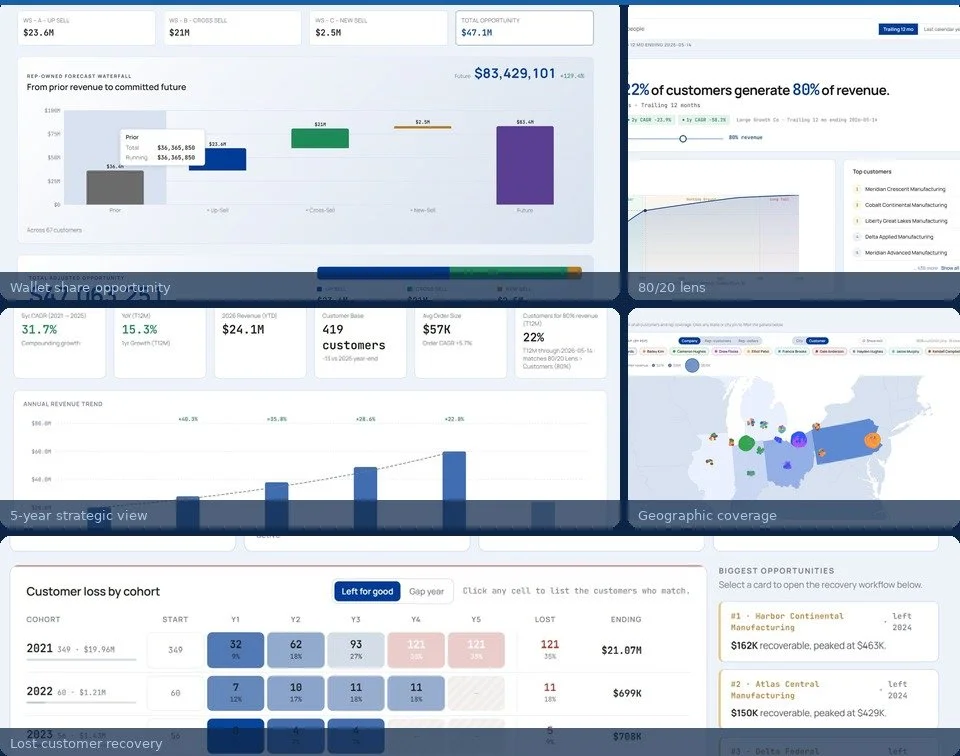
In one client’s data, $47M wallet share found | $22.3M revenue at risk identified | 146 lost customers tracked | 31.7% 5-year revenue CAGR
From Insights to Growth | 35+ years in business | Leadership team has direct experience with 500+ companies
Built specifically for middle-market businesses.
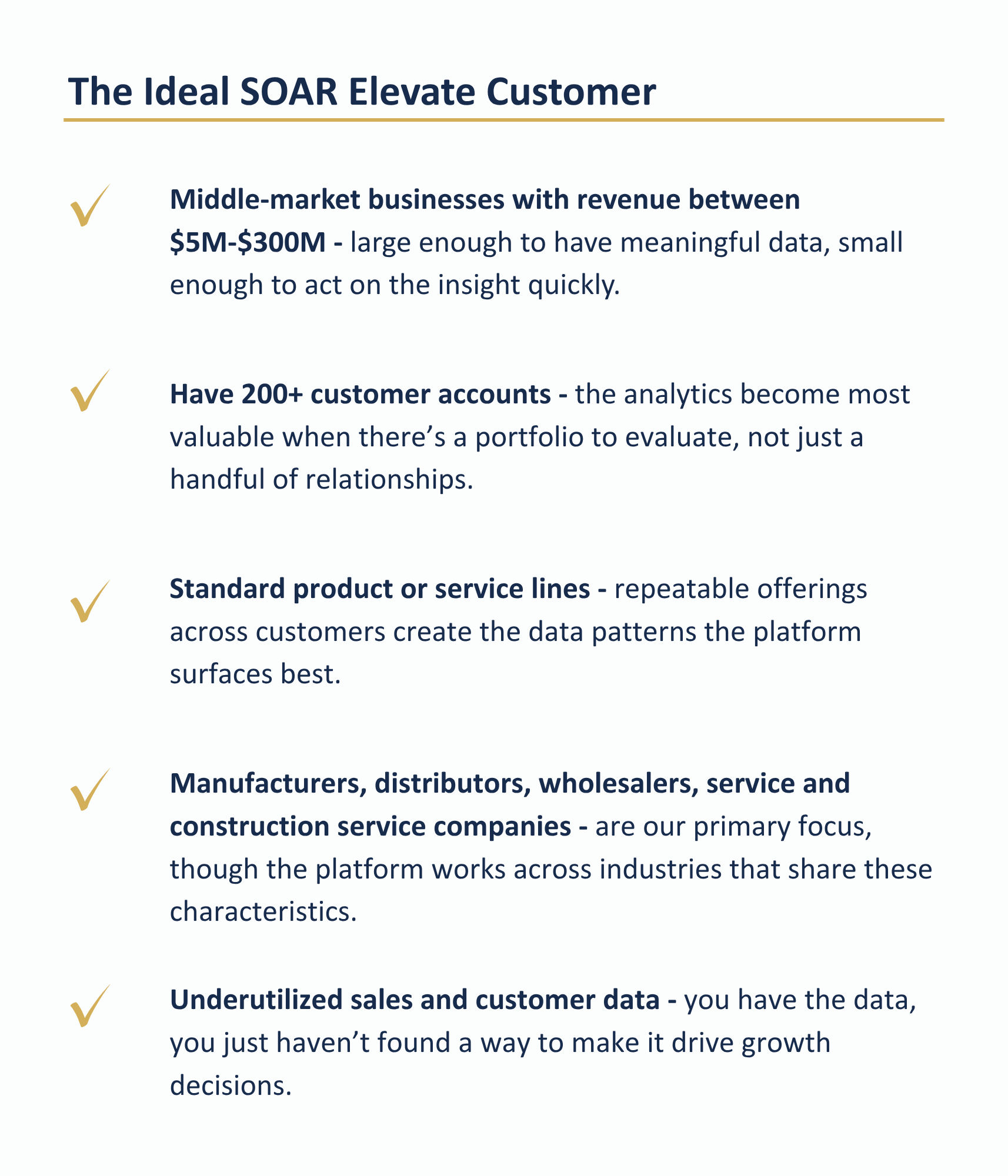
IS SOAR ELEVATE™ RIGHT FOR YOU?
SOAR Elevate is designed for a specific type of company. We’re intentional about who we work with because the platform delivers the most value when the fit is right.
“SOAR gave us an immediate return on our investment.
I wish I had done it sooner.”
Marian D., President, Rubber Manufacturer
You already have what you need to grow. SOAR Elevate helps you see it.
THE OPPORTUNITY
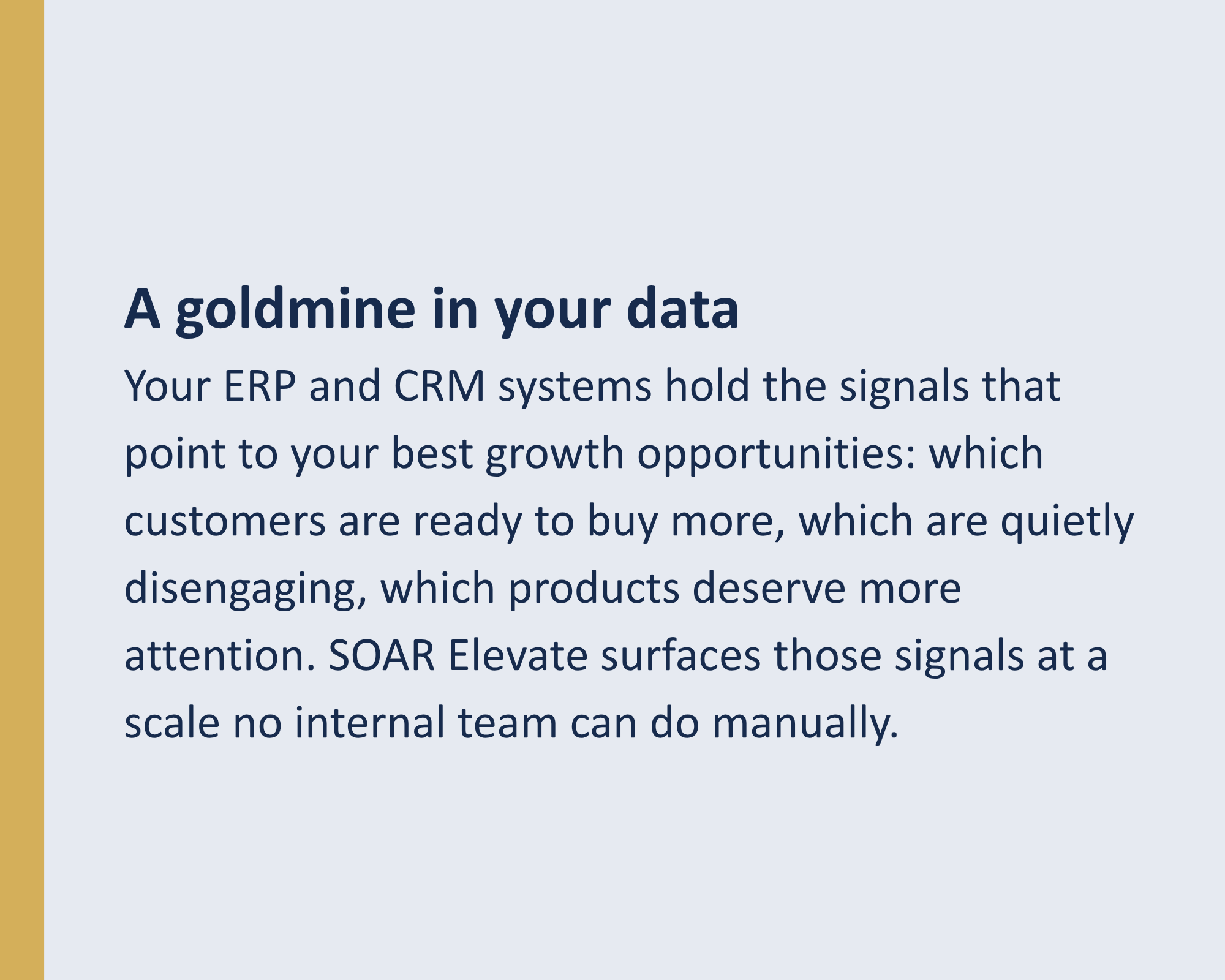
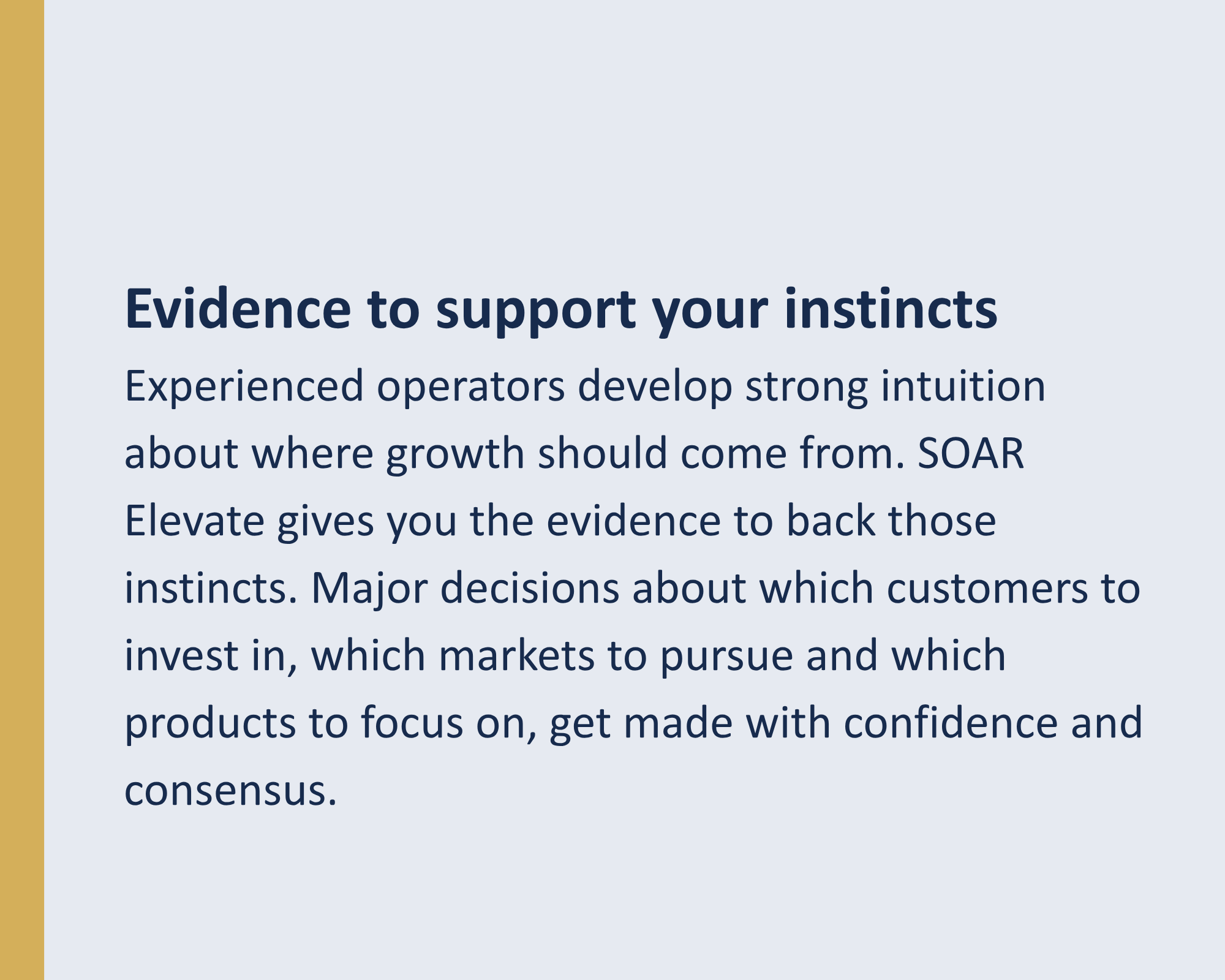
Every middle-market company is sitting on a valuable asset; years of sales history, deep customer relationships, and a leadership team that knows the business from the inside. SOAR Elevate turns that asset into your next growth plan.

Built on proven methodology, powered by our platform.
HOW IT WORKS
SOAR Elevate operationalizes the same growth methodology Parkland has used with hundreds of middle-market companies. What used to take months of consulting, our team now delivers on an ongoing basis, so your leadership team has current insight without the consulting overhead.
1 - Send us your data via a secure, encrypted portal
We handle setup.
Your export from your ERP, CRM, or your accounting system - we take it from there.
2 - Receive your Growth Opportunity Analysis
Within days, see wallet share, at-risk revenue, and more.
3 - Prioritize with your team
Every opportunity ranked based on impact factors.
4 - Act on priorities
The platform combines data and team input into a prioritized format, showing where to focus for the biggest return.
WHAT MAKES SOAR ELEVATE UNIQUE
A clear picture of where your growth lives, and how to get it.
SOAR Elevate combines your own sales and customer data with structured input from your sales team - analyzed through Parkland's proven SOAR growth lever methodology - to identify the specific growth opportunities with the highest return on your team's time.
Three reasons leadership teams use it.
WHY TEAMS ADOPT SOAR ELEVATE
SOAR Elevate isn’t a one-time report. It’s a platform that leadership teams use continuously to drive the growth conversation.
1
Surfaces the growth opportunities hiding in data most companies can’t process. The team sees things they couldn’t see before.
In one engagement, we surfaced $22.3M in revenue quietly eroding from accounts that never appeared in any report.
Makes the invisible visible
2
Gives your team a shared source of truth to anchor priority conversations, so everyone walks out of the room aligned on what to do next.
A client's leadership team identified $47M in wallet share opportunity, and for the first time, agreed on which accounts to prioritize first.
Anchors the team
3
Unlike a one-off strategic planning exercise, the platform updates as your data and team input evolve. Growth insight becomes a capability, not an event.
The platform tracked 146 lost customers and ranked recovery potential automatically, not a one-time report that goes stale.
Runs continuously
Ready to see what your data is trying to tell you?
White-glove onboarding
Our team handles data setup and platform configuration for you.
Direct access to the team
A short conversation is the best way to find out if SOAR Elevate is the right fit for your business. We’ll show you the platform, answer your questions, and help you decide.
Frequently Asked Questions
-
5 years of sales history data from your accounting system, ERP or CRM is ideal.
-
We do the set up for you. We upload a sales export provided by you, confirm how the columns map (the system auto-detects most of it), and run the analysis. If you need help determining what information is needed, we walk you through it. There's no IT project, no servers to stand up, and nothing to install. Most clients are looking at their own data the same day they send it over.
-
Yes. SOAR Elevate works from a standard export, so anything that can produce a CSV or Excel file will do, and that's basically every ERP, CRM, and accounting system out there. We don't need a live API connection or direct access to your systems to get started. If your data comes out in an odd shape, the import step is built to handle messy real-world files.
-
You get insights right away. The scoring, decline and win-back detection, and growth recommendations show up as soon as your data is analyzed. Actual revenue results follow once your reps start working the opportunities the system surfaces, which is usually a matter of weeks, not quarters, because it points them at specific accounts and specific actions instead of "go sell more."
-
Those are blank canvases. You (or a data analyst) build the dashboards, decide what to measure, and figure out what it all means. SOAR Elevate comes with the analysis already done. It scores your customers, finds the ones quietly slipping away, sizes your share-of-wallet gaps, and then tells each rep which accounts to call and why. BI tools show you charts. SOAR Elevate shows you the analysis and hands your team a to-do list.
-
Yes. Each client's data is kept isolated in its own secure environment, it's never shared with other clients, and it's never used to train public AI models. It's your data, used only to run your analysis. We're glad to walk your IT or security team through exactly how it's stored and protected.
-
No. All we need is an export (and we can tell you what fields we need). SOAR Elevate’s analysis happens under the hood. Your people just act on what it finds.
-
That's normal, and the import step expects it. The system flags gaps, fills in what it safely can, and is upfront about anything it can't determine rather than guessing. You don't need to clean everything up before you start.
-
No, your team doesn’t log into or navigate the platform. We run the analysis and return the findings to you in a format built around what a salesperson actually needs: which accounts matter, which are at risk, and what to do about them.
-
Absolutely, and we'd encourage it. Loading your real sales history and seeing your own customers ranked and your own at-risk accounts surfaced is the fastest way to know if this is worth it. You don't have to take our word for what it'll find.
-
Every score and recommendation traces back to your actual sales numbers, not a black box. You can drill into any customer and see the revenue history, the trend, and the reasoning behind the call. SOAR Elevate helps explain and prioritize, but the math underneath is yours to check.